PRINTED WORD REVIEWS




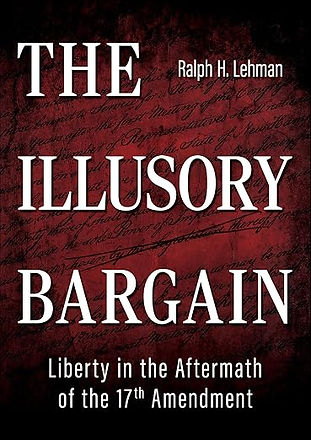
The Illusory Bargain: Liberty in the Aftermath of the 17th Amendment

Ralph H. Lehman
17th Amendment, direct election, tyrannical governance, Federal Reserve Act fiat currency
Brown Books Publishing


Share this review:
A historical analysis of the United States government, arguing that the Seventeenth Amendment and the Federal Reserve Act resulted in the proliferation of tyranny.
When it comes to diagnosing the ills that plague the modern American government and society, Ralph H. Lehman is straight to the point. The Illusory Bargain is a rigorously researched and unyielding critique of what Lehman describes as tyrannical governance, or “arbitrary laws and the arbitrary government that enforced them.” The book starts off by outlining the formation of the United States government, quoting heavily from the founding fathers, and introducing the idea of a “mixed and balanced government.” Emphasizing the concept’s lineage from Greek political thought, he explains that the nation’s founders intended for the government to be a balance of monarchy, democracy, and aristocracy. Monarchy took the form of the president and the executive branch, democracy could be found in the House of Representatives, and aristocracy was represented by the Senate, which was originally elected by state legislatures.
Lehman argues that the country’s downward trajectory towards tyranny began with the passage of the Seventeenth Amendment, which allowed for the direct election of senators by the people. This tyranny has extended much further because of the Federal Reserve Act with its fiat currency. He argues that the dissolution of the natural aristocracy in the government made room for a “pseudo-aristocracy,” which has been largely responsible for an oligarchical concentration of power and the unjust application of laws. In breaking down how this amendment unsettled the intended government structure, Lehman establishes and explains three frameworks that he asserts were crucial to the “mixed and balanced” model: the Functional, Fractional, and Foundational Frameworks. From the Civil War, to the passage of the Federal Reserve Act, to the 2008 financial crisis, Lehman traces how the wealth and interests of few have resulted in the devastation of many.
Lehman’s work is thoughtfully articulated, analytically rich, and hopeful. In addition to his analysis of our problems, Lehman also identifies a path for restoring our republic/limited government. To be sure, his position is ideologically situated and his reasoning follows suit. In covering such a wide swath of history, the emphasis of certain political moments or economic outcomes, and the dismissal of others, is inevitable. Perhaps the most politically situated aspect of Lehman’s work is the modern-day events which he chooses to highlight as examples of tyrannical governance. With that said, Lehman’s text is significant in its illumination of the Founding Fathers, and how in many ways the shape of our modern government has diverged from their blueprint. Readers seeking a historically informed argumentation of the United States’ political woes will be glad to pick up Lehman’s latest work.
