PRINTED WORD REVIEWS





self-worth, belonging, identity, confidence
Morgan James Kids


Share this review:
A lonely bunny in a bustling forest discovers her worth, belonging, and voice through the support of her friends and the stories she dares to share.
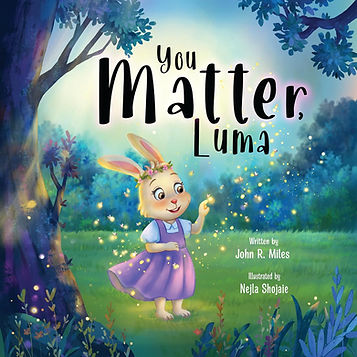
In a world that often measures worth by productivity and “busyness,” John R. Miles’ debut children’s book, “You Matter, Luma,” offers a soul-soothing counter-narrative for the youngest generation. Transitioning from the high-stakes world of corporate leadership and personal development into the gentle realm of picture books, Miles brings his “Mattering Revolution” to the forest floor, creating a story that is as much a hug as it is a lesson.
The story follows Luma, a small bunny who lives in a forest vibrating with purpose. Around her, birds chirp with confidence, fireflies dance with rhythmic grace, and ants march with a sense of duty. Against this backdrop of constant movement, Luma feels static and separate. She is the quiet observer, wondering if her smallness equates to insignificance.
The narrative arc is paced for children ages 4–8. It begins with Luma’s internal questioning, a feeling many children (and adults) recognize but lack the words to describe. Her mentor-figure, Oliver, introduces the book’s central metaphor: a glowing tree. He reminds her that every towering oak began as a tiny seed, and that “Ideas grow the same way. With care, they take root and bloom.” This sets the stage for Luma’s slow-burn realization that her value is an internal seed, not an external achievement.
Miles doesn’t shy away from the reality that self-belief is fragile. In the middle of the book, a literal and metaphorical storm breaks. The contrast between the warm, hopeful glow of Luma’s first “sprout” of confidence and the damp, dark discouragement of the rain is striking.
Luma’s reaction to the storm is curling up tight, feeling that her stories and her worth have been washed away, is a poignant moment of vulnerability. It is here that the book shines brightest, showing that “mattering” isn’t a constant state of sunshine, but something that persists even when we feel dampened by life’s circumstances. The support of her friends Zin, Sage, Wren, and Theo all highlight the importance of community in nurturing our individual light.
The climax takes place in the heart of a cave, where the atmosphere shifts from the wide, overwhelming forest to an intimate, firefly-lit circle. When Luma finally emerges, she finds the courage to say, “I have a story to tell.” It isn’t just about the words she speaks, it's about the space she finally allows herself to occupy.
Here the resolution is particularly empowering. Instead of ending solely on Luma’s success, the book turns the mirror toward the reader. Her next words are her final question: “What’s yours?” This transforms the reading experience from a passive story into an active invitation. It reinforces the core message: mattering is a shared human (or bunny) experience.
While the text is reflective and gentle, the manuscript promises high-impact visual contrasts. From the ethereal, dreamlike clouds representing untapped potential to the cozy, firefly-lit cave, the imagery serves to ground Miles’ philosophical concepts in a way that is digestible for a preschool and early elementary audience.
“You Matter, Luma” is a vital addition to the “social-emotional learning” (SEL) bookshelf. It successfully distills complex psychological needs: the need to be seen, known, and valued. It teaches children that their voice isn't just a sound, it’s a gift that the world is waiting to receive. Recommended for bedtime reading, classroom discussions on self-esteem, and any child who has ever felt “too small” for a big world.
