PRINTED WORD REVIEWS




In Conversation with Xuemo
October 26, 2026 at 7:59:27 AM
This “Tea with Ted” Interview took place on October 7, 2026, 15:00 in Germany at Frankfurt Book Fair, Hall 5.1, Stand B77 / ZOOM / Riverside connection
Speakers:
Ted Olczak is the President & Publisher of Printed Word Reviews / Printed Word Reviews En Español / BOOKCamp magazine / FALCON Review / NYC Big Book Award / Independent Press Award / Childrens Bookworm Award
Xuemo
Xuemo, born in 1963 as Chen Kaihong, is a renowned writer from Gansu, China. He has written over 80 books, published in more than 200 editions, with translations available in over 30 languages.
Xuemo’s novel Into the Desert won the 2022 Excellent Translation Award by the China International Communications Group (CICG), the 2024 NYC Big Book Award for Women’s Fiction and the 2024 Independent Press Award for Literary Fiction. His novel Curses of the Kingdom of Xixia won the 2024 NYC Big Book Award for World Literature. The novel Wild Fox Ridge was also honored with the 2025 International Book Awards and 2026 NYC Big Book Award. He has been nominated three times for the Mao Dun Literature Prize and has won the Dunhuang Literature and Art Award six consecutive times.
The e-book editions of Desert Rites, Desert Hunters, White Tiger Pass, Love Letters from the Goddess, Eternal Love and Reclaim the Throne of Your Heart have repeatedly ranked No. 1 on Amazon’s bestseller lists.
Ted Olczak: Hello, Xuemo! We are currently at the Frankfurt Book Fair, and we are delighted to meet you. You write profoundly about desert culture, meditative practice, and wisdom.
Tell us about how growing up in Gansu influenced your writing. In particular, how does the silence of the desert landscape shape your prose?
Xuemo: Thank you, Ted, for visiting our booth at the Frankfurt Book Fair. I have written many books about the desert. I often place people in extremely harsh natural environments rather than in great cities, because it is under such severe conditions that the full stature of the human spirit can emerge.
I love the desert, and I love solitude. My nearly twenty years of retreat practice were devoted to reclaiming ownership of my own mind and cultivating wisdom. My novel The Undying Diamond Heart explores how a person can overcome desire, preserve human dignity in a harsh environment, and attain a wisdom that transcends ordinary human understanding.
The protagonist’s life journey is one that anyone can, in principle, undertake. His experiences reflect universal aspects of human life, which is what makes his story so valuable. The book presents not only his philosophy but also his methods. Through the gradual practice of inner cultivation, readers may likewise move beyond their limitations and develop wisdom. Much of the material is being presented to the public for the first time. Publishing the book in English could therefore have a positive and beneficial impact around the world.
Ted Olczak: In your books Eternal Love and The Undying Diamond Heart, we want to know more about your craft surrounding the ‘spiritual quest’ and use of mysticism.
In both your books, you implement visionary realism. The visions, dreams, and spiritual tests are as tangible as mountain passes and snowstorms. When writing about mystical realms, like Niguma’s domain in “The Undying Diamond Heart,” how do you balance fidelity to sacred Buddhist tradition with your own creative, literary imagination?
Xuemo: Much of the book is both fiction and an account of my own lived experience. Because I have experienced these things myself, I was able to write about them with conviction. I have undergone everything the protagonist goes through. His journey portrays the extraordinary experiences that may arise as a person gradually moves beyond the self. These experiences seem at once artistic and profoundly real; they feel authentic because they are rooted in the author’s own life.
They arise from the writer’s imagination, but they are also experiences that transcend ordinary perception. Without having experienced them, a writer could not render them in this way. Through sustained practice, anyone can potentially arrive at insights beyond ordinary awareness. This is one of the powers of art and literature.
Ted Olczak: In “The Undying Diamond Heart,” Khyungpo Naljor’s enlightenment isn't a quiet meditation; it’s forged through avalanches, slander, physical beatings, and grief. Do you view suffering as an absolute prerequisite for spiritual awakening, or is it simply the most reliable teacher?
Xuemo: Suffering is not necessarily what brings about spiritual awakening. Its importance lies more in the testing, deepening, and refinement that follow awakening. At that stage, suffering matters because it tests whether the awakening is genuine and complete. Snowstorms and other hardships are simply among the experiences that may occur along the path; awakening can also happen without them.
Hardship tests whether a person can remain awake in the face of adversity. If that awareness endures through suffering, it is a more fully realized awakening. If it cannot, the awakening may not yet be deep enough.
Awareness is like a torch, and suffering can be like the wind. A strong wind may extinguish the flame. But as a person gains experience, that torch can grow into a bonfire, then into a great blaze spreading across the sky. Suffering can contribute to this transformation. When awakening is tested by hardship, its flame can grow stronger until no wind can put it out.
If life is a play, awakening means recognizing that it is a play. Suffering supplies its varied and dramatic scenes. At times, the more hardships the play contains, the more compelling it becomes—much like a film whose protagonist’s journey grows more unforgettable with every challenge. To awaken is to understand that you are watching and performing in a play without becoming wholly trapped in it. You step back and observe the role you are playing.
Ted Olczak: In your writings, you explore the spiritual attainment paradox of devotion versus renunciation. The unconditional love that separates us from the physical world and our attachment to it in order to be more spiritual. For example, in both novels, romantic love and human attachment play pivotal roles—such as Khyungpo's tragic bond with Sarwadee. How do you address the tension between the transcendent love required for spiritual awakening and the earthly attachments that often ground us as human beings?
Xuemo: That is an excellent question. Transcendence is a state of being reached through the elevation of one’s inner life. Yet when a person encounters the world from that state, love and wisdom must go together. If transcendence becomes mere withdrawal, leaving a person unable to relate to the world, it loses its meaning.
Transcendence is an inner realization, but in responding to the world, one must turn its wisdom into love and compassionate action, build meaningful relationships, and help others find their own way beyond limitation.
In Buddhist terms, individual transcendence alone is associated with the ideal of the arhat. To go further—to help others who are ready to do so attain transcendence as well—is the path of the bodhisattva. My own aspiration is not only to transcend my limitations, but also to share the love and wisdom that follow from that transformation, so that others may experience it too. Transcendence is an inner state; engaging with the world is an active way of living.
Ted Olczak: Khyungpo Naljor begins his journey by publicly admitting he no longer believes in the Bon tradition he inherited, giving up his inherited wealth and religious title. In an era where questioning dogma often leads to exile, what does his story teach modern readers about the courage required to confront one's own crisis of faith?
Xuemo: Faith and the search for truth often begin with a rejection of what came before. Without questioning the past, it is difficult to embark on a new search. It is like installing a new program on a computer: the old program must first be cleared away.
When we genuinely seek something or commit ourselves to a path, we must be prepared to relinquish what we previously held on to—whether worldly ambitions or a position of religious authority within the Bon tradition. Without this willingness to let go, a true search cannot begin.
Faith cannot be half-hearted. Either we do not believe, or we commit ourselves fully. We cannot cling equally to the old and the new. Genuine faith calls for wholehearted commitment. This is why Khyungpo Naljor had to leave his former life behind as he pursued what lay ahead.
The same principle applies today. When we seek something new or aspire to inner transformation, we may need to let go of our pursuit of countless desires. If we believe in peace, we must loosen our attachment to violence. If we seek what is good and beautiful, we must be willing to break decisively with what is false, harmful, and ugly.
This is a matter of choice. One of humanity’s greatest capacities is the ability to choose, and our choices determine the heights we can reach. Khyungpo Naljor’s life demonstrates the power of such a choice: he set aside worldly judgments and pursued truth—truth in its purest form.
Ted Olczak: You have written extensively about entering a meditative, flow-like state while writing your Silk Road and Western China epics. How much of Khyungpo Naljor’s internal transformation was mapped out in advance, and how much revealed itself to you in the act of writing?
Xuemo: The subject and direction of a work should be considered before writing begins. Yet when the writing itself starts, the words should flow with the force of a spring bursting from the ground. Some people call this “flow.” In Eastern thought, however, it might be described as the mind flowing from its original nature.
When I write, I have a direction. I know what I want to write about, and I prepare the subject matter in advance. But once I begin writing, I enter a state of complete flow. This state differs somewhat from what is commonly described as flow in the West. Western accounts tend to frame flow as a state of consciousness; in my experience, it also involves the arrival of an immense force from beyond myself.
My body feels an extraordinary surge of joy. My muscles seem to tremble, and my chest feels as though a furnace were burning inside it. I can sense a powerful force entering from outside. It is not simply a flow of thought or consciousness. It resembles flow, but it also seems to involve an influx of information and energy from beyond me.
I can see the world I am writing about and enter the spaces I describe. I can see the many different worlds taking shape on the page, as though I could step into places and times in the past. This influx of information and energy is what distinguishes my experience from flow understood as an entirely individual mental state. My writing connects me to the wider world; it is a form of flow that is connected, as if online, rather than confined to my own consciousness.
Ted Olczak: The world today is marked by rapid change, anxiety, and shifting values. What do you hope a modern, secular reader, that is to say, someone who may never set foot in a monastery or step onto the Silk Road, eventually takes away from the concept of “The Undying Diamond Heart?”
Xuemo: The world is becoming more complex, with more wars, violence, and anxiety, for many reasons. Some are political; others are economic, rooted in capital. Yet beneath them all lies desire. Desire often begins as a thought, and humanity’s troubles arise when people become governed by these desires.
My hope is that readers of The Undying Diamond Heart will first learn to reclaim ownership of their own minds. The world is made up of one game after another. We can observe these games without allowing them to take control of us. Different groups and power structures establish their own rules and systems in pursuit of greater gains. Most people do not recognize how these games work, and so they become captive to them.
Recognizing that the world is a game—and learning to keep your mind your own—is a form of awakening. The Undying Diamond Heart explores a path toward this awakening. I hope that its wisdom will give readers a new perspective: the ability to see beyond the games driven by desire. Such perspective is badly needed in an age when we are so often captured by desire, algorithms, and capital, and no longer feel that our lives belong to us.
The book explores the way to see through these games and reclaim inner freedom. When readers encounter its ideas, I hope they will awaken their own wisdom, recognize the games at work, and take a step back rather than being swept along by them. From a place of inward awareness, they can begin to shape a world of their own.
In that world, each person is the creator of their own inner universe. Once you recognize that you are its creator, you become the master of your own world and are no longer so easily controlled by others.
A Literary Bridge Between Cultures
Ted Olczak: I’m genuinely astonished. Your literary storytelling serves as a kind of bridge, while your wisdom seems to connect different parts of the world—different places and cultures, beyond national boundaries. It is remarkable.
Xuemo: I can share this method with any university, in any country, and with people from all walks of life. It is not some unattainable form of wisdom; it is a series of steps that anyone can work through, one by one. That is very important. I hope you will preserve this point, Ted, so that in the future we can work with universities and introduce the method to students and to anyone interested in Chinese culture. They, too, can develop this kind of awareness. Many of my readers have already done so. This is a science of life, not something esoteric or mysterious.
Ted Olczak: Thank you very much. I look forward to helping share your culture with a wider audience. I very much hope you will be able to attend next year’s awards ceremony. Congratulations on your award: your book Eternal Love has received the NYC Big Book Award. I hope to see you at the next year's ceremony. Thank you for your time and for sharing your wisdom.
Reported by Printed Word Reviews
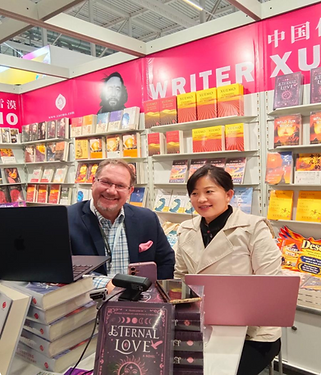
A highlight of this year’s fair was an in-depth conversation on October 7 between Xuemo and Ted Olczak
Share this article